Sunday, April 15, 2012

Don’t Ask, Don’t Tell? A Few Thoughts on Public Veganism

It’s April 15th!  Today marks the halfway point of my month of veganism, and friends, I have confessions to make.

I feel like I should have some before-and-after pictures for this project, but I’m pretty sure that I look and feel exactly the same.  I’ve heard many people say that they felt so much better once they started following a vegan diet, but I am not one of them.  Part of the magic in other people’s stories, I think, is that the change in eating habits was very dramatic.  They went from eating a junk-food diet, with plenty of fast food, meat, sugar, alcohol, caffeine, and very few vegetables to a diet loaded with fresh produce.  In my opinion, just eating more fresh produce is a powerful way to improve your diet.  And if you fill up on healthy stuff, you’re more likely to feel satisfied and less likely to eat junk.  It turns out my parents were right.

Vegan or not, I have a pretty healthy diet, so I’m not expecting dramatic results from this experiment.  What I am discovering is how hard it is for me to be publicly vegan, knowing that I haven’t committed to a vegan lifestyle for the long haul.

Let’s start with the easy part: the food I eat at home.  It’s been pretty easy for me to stick to my vegan experiment at home, especially once I found some vegan probiotic foods to keep my belly happy.  A few changes to my routine have made it easy to eat vegan meals and snacks.  I’ve been rotating through different non-dairy milks, enjoying the variety of flavors.  I’m tinkering with the cashew cheese recipe, which really does satisfy my craving for something cheeselike.  I think I’m getting closer to a good ricotta-like version of the cashew cheese, and I’ll post the recipe when I’m happy with it.  And finally, I’ve been eating a lot of tofu, trying different recipes and making notes to myself about what I like best.

But eating outside of my home?  I have failed to stick with my vegan intentions.  Failed, with a capital F.  I crumbled almost immediately, which is embarrassing.  Last week, my friends Anne and James were in town, and we went out to eat at Genghis Grill.  I love their red curry peanut sauce, which isn’t even vegetarian!  Whoops.  I think it has shellfish in it.  To be honest, that is the sort of blip on my vegetarian radar that I’m willing to ignore.  I would prefer that it was vegetarian, but eh—I can’t get myself too worked up about it.  After Genghis Grill, we went to Tutti Frutti, a new frozen yogurt place in town, where we proceeded to mmm and ooh our way through the various samples.  It was totally delicious, and totally not vegan.

The next day, I had two hours of work meetings in the afternoon, and at the end of that long block of listening to other people, I was tired and hungry.  I brought some snacks with me to the second meeting (cashews and dried cranberries), but when the pizza showed up, covered in melted cheese, I…I ate it.  Three pieces of it.  And yes, it was delicious.  I was certain to avoid the pizzas with meat on them (which was the majority), but it was definitely a vegan fail.

Finally, on Friday afternoon, I was feeling bored and tired at work and without even thinking about it, I grabbed a piece of chocolate from an open bag, unwrapped it, and bit into it.  Then I thought, Oh, crap.  Because sure enough, it was milk chocolate.  I like the flavor of milk chocolate, but it’s supposed to be off-limits this month.  Off-limits, not melting on my tongue in a flood of sweetness.

So what’s the common denominator here?  I think there are two: social situations and work-related fatigue/boredom.  The level of preparedness that I would need in order to avoid dairy when I’m not at home is high.  I’d have to know which restaurants around town have vegan options or will let me custom-order a vegan meal.  I’d have to know where to find vegan desserts around town.  At work, I would have to be ever ready to say no to dairy, even when I’m tired and hungry and want to catch up with my friends while we sit around eating pizza.

But I think there’s an additional layer of complexity here, which is that I don’t feel like a true vegan.  I’m not ready to come out as vegan because I haven’t committed to veganism beyond the end of this month.  I feel bad inconveniencing people during these dairy-free days, and that’s very different than how I feel about not eating meat.  I am totally willing to insist that my friends and I eat in restaurants that have good vegetarian options.  I won’t go to a steakhouse or a barbecue joint, because what’s the point?  I don’t want to patronize restaurants that glorify meat-eating, and I don’t care to be the only vegetarian in the room at those places.

I am willing to keep trying, for the sake of my project, to find ways to eat vegan food when I’m not eating at home.  It’s tough, especially outside of a big city.  Perhaps it would be easier in Austin than in College Station, but I won’t sit around bemoaning my fate here in small-city, conservative Texas.  I’m going to keep trying, and I’ll report back at the end of the month to let you know if I made any progress in this domain.  For now, I will leave you with a few photos of my weekend, at home and out and about.

Welcome Sign

Vising Chappell Hill, Texas for the annual blue bonnet festival
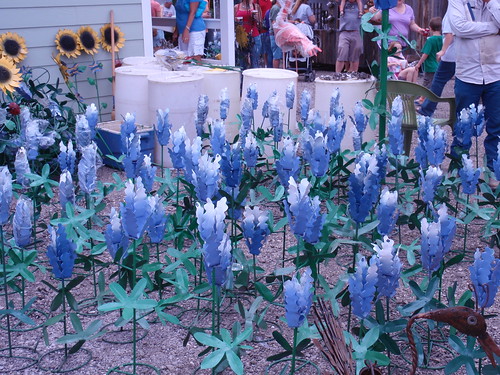
Fake Blue Bonnets

Fake blue bonnets at the festival.  I think blue bonnet season arrived early this year because of all the rain we’ve had this winter.
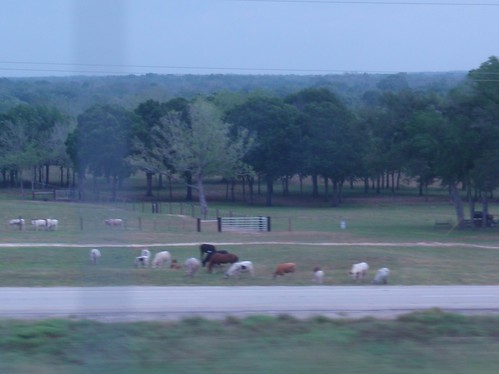
On the Road in Texas

Grazing cows and horses as seen from the car.
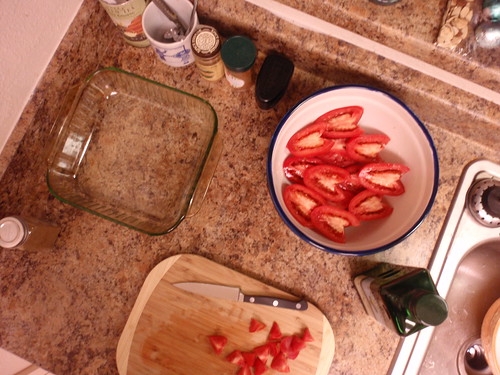
Sunday Morning

Sunday morning at home, prepping Roma tomatoes for slow roasting

Wednesday, April 11, 2012

Healthy Vegan Bellies

There are two really fun things about my job.  The first is that if I can make the time, I have the opportunity to listen to world-class scientists talk about their work.  It’s always such a treat to listen to a good speaker talk about a topic in which I am interested!  The second is that I’ve been schooled in what makes for good science.  I can articulate why I think a particular study has something valuable to tell us.  Likewise, when science is bad, inadequate, or even just overstretching the limits of its own results, I can describe, with some rigor, why I think a paper sucks.  With a science PhD comes a certain amount of power.  I like it.

Nutrition is my “hobby science,” meaning that I don’t study human nutrition formally, but I am interested in it for personal reasons.  And within that area, I am really interested in gut bacteria or “intestinal flora,” to put it more nicely.  It seems that there is an emerging consensus within the scientific community that intestinal flora are really important, but we’re really just scratching the surface in our understanding of them.  I try to go to as many talks about this subject as I can, most of which are centered around the role of gut bacteria and inflammation.

I’m prone to belly troubles every once in a while, and it seems to be linked to gut bacteria and probiotics.  Eating yogurt tends to help my belly troubles.  Last week, I noticed some intestinal distress (as my friend Asmodeus might put it), though I’m pretty sure my distress was not from drinking wine!  I didn’t make the belly distress-probiotics connection right away, but I figured it out in time for my weekend grocery run.

Vegan Probiotics Round One

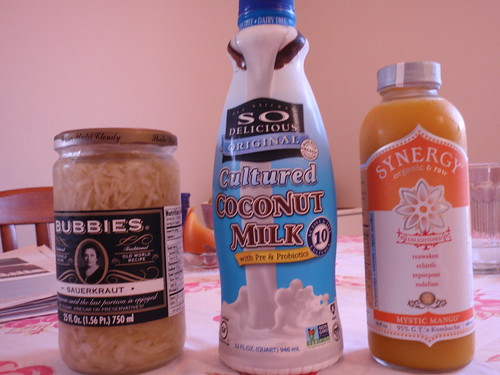
Here’s a funny thing: I can’t remember ever reading an article, on-line or in print, about vegan probiotics!  I find this hard to believe, considering my voracious reading appetite.  But it’s true, so I had to go with my gut (har har!) when picking out some vegan products with live cultures.  Let’s take a stroll through the shopping aisle together, shall we?

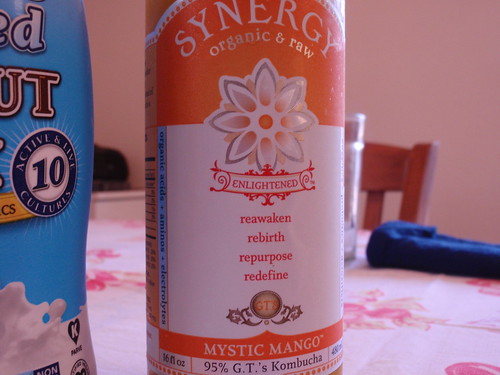
Synergy Kombucha 

* Synergy Mystic Mango Kombucha.  I confess, I am not crazy about kombucha.  It can be pretty sour.  I think it may be a bit of an acquired taste, but I do like this mango flavor.  It’s got some nice carbonation like pop (soda for the non-Michiganders out there), but it’s pretty low in sugar and it’s got live cultures!  The mango flavor is subtle but nice.  I would buy this again.

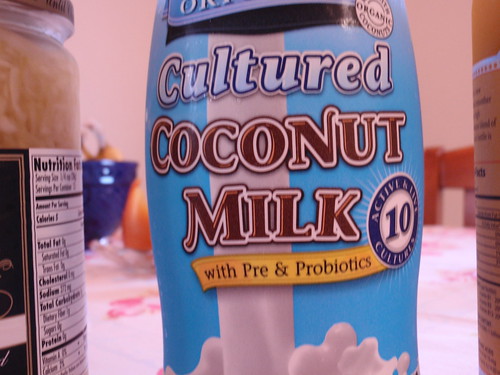
So Delicious Cultured Coconut Milk

* So Delicious Cultured Coconut Milk.  This beverage is a pourable coconut yogurt.  It is surprisingly glossy and somewhat viscous, like canned coconut milk.  It’s a little sweet and a little tart, and the coconut flavor is understated.  I’ve been using this on my morning bowls of oatmeal, and I like it.

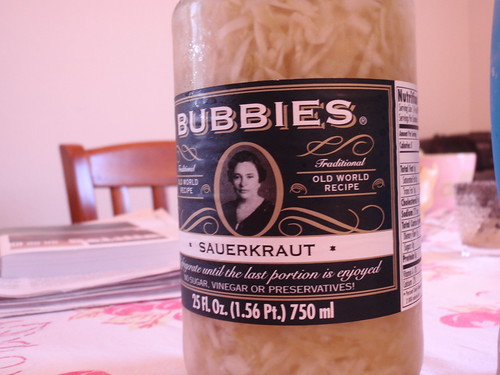
Bubbies Sauerkraut

* Bubbies Sauerkraut.  In my family, we are crazy about Bubbies sauerkraut and cucumber pickles.  They’re totally delicious and taste exactly as you’d expect pickled vegetables to taste.  I think they are a nice change of pace from the slightly sweet kombucha and cultured coconut milk—pickles take you in a savory direction.  (And side note: my brother likes to stuff sauerkraut into his grilled cheese sandwiches, and they’re terrific.  If you have a meltable vegan cheese you like, it might be worth adding some Bubbies it!)

The good news is that all these probiotics seem to be doing the trick: my belly is much happier this week.  I’ve been eating at least one cultured food each day and sometimes more than one—for example, I’ll have the yogurt at breakfast and sauerkraut with lunch or dinner.  A healthy belly is a happy belly.

Tuesday, April 10, 2012

What Exactly Is Eating Grass? (A Rant About Language)

(Pardon me while I rant a moment.  If you’re not into ranting, check back here tomorrow for some discussion on vegan probiotics!)

Can you tell me what is wrong with this next sentence?  “We eat a lot of grass-fed beef.”

I’ll tell you what’s wrong with it.  It’s the phrase “grass-fed beef.”  Beef, as I understand it, doesn’t eat anything.  Because beef is dead.  It’s the chopped up remains of a dead animal.  That animal was once a cow, and it’s been transformed into beef.  I object to the transformation of language that we use to distinguish living, breathing, eating animals from the dead ones that become beef.

I hate the language of meat.  I find it deeply offensive that we have so many words to describe the body parts that we remove from the animals we have killed.  I hate the words beef, pork, and poultry.  I think it speaks volumes about our bloody hands that we use different language for food than we do for the living animals that become our food.  Of course this isn’t the case with all food: we talk about eating chicken or turkey or duck or even alligator.  But to that counterexample, I love what Colleen Patrick-Goudreau says: “Do you eat chickens?”  Notice the plural.  Because if you eat meat, you aren’t just eating chicken.  You are eating chickens, many of them over the course of your lifetime.  And think about vegetables for a moment.  I wouldn’t ask someone, “Do you eat tomato?”  I’d ask, “Do you eat tomatoes?”  Though it is interesting to note that when we talk about not liking something, we’re more likely to use the singular: “I don’t like eggplant.”

Back to the issue of grass-fed animals.  I do think that people who seek out grass-fed cows are to be applauded for choosing the healthier, more environmentally responsible choice.  I don’t want to eat grass-fed cows, but as an environmental vegetarian, I feel like we have common ground in our concern for the health and welfare of the animals, the humans who raise them, and the nutritional profile of the food.  I believe that there will always be people who want to eat meat, and I’d rather they have a more humane choice than factory-farmed animals.

Still, the phrase “grass-fed beef” just doesn’t work for me.  Neither does “pasture-fed meat,” or any variation that doesn’t reflect the idea that these were living animals that were eating grass.  The language gets even trickier when we’re talking about milk from grass-fed cows.  “Grass-fed butter”?  That doesn’t even make sense!  To get around this problem, I take the time to say “butter made from the milk of grass-fed cows.”  Because I want to remind people that all these animal products, whether it’s meat, milk, butter, or eggs, come from living animals.  As soon as our language starts to slip away from that reality, we are distancing ourselves from the realities of our food supply.  What the cow eats, I eat.  And if the cows are sick, as so many of them are on factory farms and feedlots, I will become sick.  Maybe not today or tomorrow from E. coli, but perhaps twenty years from now with heart disease or cancer.

I feel really passionately about this issue.  When it comes to food, we all have to choose a side because we all have to eat.  Whether or not you eat meat dead animals, you have chosen a side in the political battle that is food.  I want to come down on the side of health, compassion, and sustainability, and all three of those things require that we see things clearly.  We have to see ourselves as connected to the means by which our food is grown, and to me, that means seeing animals as living animals, not just the “grass-fed beef” that might show up on your dinner plate.

Sunday, April 8, 2012

Creamy, Tangy Homemade Cashew Cheese

I knew I wouldn’t be able to make it through a month of veganism without cheese.

I KNEW IT!  And I came prepared for it.

Homemade Cashew Cheese

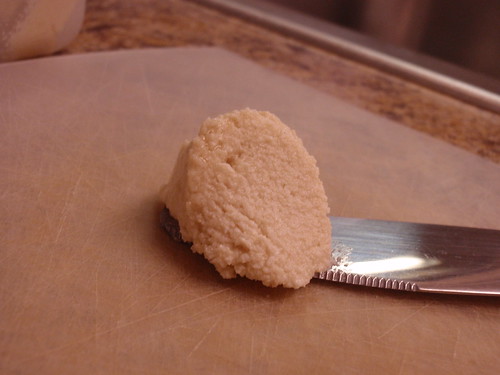
I first tried this homemade cashew cheese about three years ago.  I convinced my Chicago friends Ammie and Rebecca to have a vegan cheese party with me.  We would each make a different vegan cheese and I would host a tasting party in my kitchen.  It was a lot of fun—we ate and laughed and had a merry time.  But what I remember most was this cashew cheese.  It was delightful—surprisingly creamy, with a taste reminiscent of goat cheese but a texture that was more like ricotta.  It had a little bit of an edge to it, too, the way that a good cheese does, a flavor that stops you in your tracks as you say, “Wow, that’s kind of funky!”  But it’s funky in a good way, a flavor that adds interest to everything you slather it on.

Colleen Patrick-Goudreau is fond of saying that it’s not necessarily cheese we crave, but fat and salt.  She’s got a point, but cheese, as a category of food, offers so many unique flavors.  I think that’s one of the reasons we love it so much—yes, it’s the salt and fat, but it’s also the variety of tangy, funky, crazy flavors.  And if you pair cheese with wine, as people have been doing since time immemorial, the flavor combinations are nearly endless.  As a happy hour appetizer, cheese and bread is hard to beat—it’s satisfying but not too heavy, and it lets you linger over your wine a little longer.

I don’t think vegans should be denied the pleasure of cheese.  Homemade cashew cheese is an easy way to satisfy that craving.  You do need to plan ahead a bit if you want to make this for a specific event, because the cashews need to be soaked overnight, and then the cheese is aged at room temperature for 12 hours.  Other than some advanced planning, this is easy kitchen work.

I like this cashew cheese so much that I’m working on a sweet version now, playing with the idea that this ricotta-like texture could swing in a different flavor direction.  If it’s any good, I’ll report back.  For now, enjoy the original recipe.

Homemade Cashew Cheese

From Vegetarian Times, April 2009

A word about the canola oil: the final cashew cheese can be a touch oily, and I think it might be possible to use less oil—perhaps 4-5 tbsp. instead of 6?  I haven’t tried it yet myself, but it’s worth considering.  Another fun idea would be to use different oils—subbing in a tablespoon or two of olive oil would add a grassy, fruity flavor to the cheese, which sounds delicious to me.

3/4 cup raw cashews

6 tbsp. canola oil (1/4 cup + 2 tbsp.)

1/4 cup lemon juice

1 tbsp. tahini

1 1/4 tsp. salt

1)  Put the cashews in a large glass or bowl and cover with water by a few inches.  Cover and soak overnight.

2)  Drain the cashews and rinse them under cold water.  In a food processor, puree the cashews with the rest of the ingredients listed above.  Puree for 6 minutes, scraping down the bowl of the food processor every minute or two.  You really want to puree the heck out of this mixture because it’s essential for a really creamy texture.

3)  Set a strainer in a large bowl, and line it with three layers of cheesecloth.  Scrape the cashew mixture into the cheesecloth and fold the sides of the cheesecloth over the cashew mixture.  Secure the ends with a twist tie, and let the mixture stand for 12 hours or even longer.  I think I let mine go for a day, and it was fine.

4)  Preheat the oven to 200 degrees F.  Line a baking sheet with parchment paper.  Untie the twist tie from the cheesecloth, and set the cashew cheese (still in its cheesecloth) on the baking sheet.  Use your hands to form it into a log.  I find it easiest to do this by not removing the cashew cheese from the cheesecloth but rather I just shape the log inside the cheesecloth.  If you like, you can twist the ends of the cheesecloth and secure them with a twist tie, but I don’t find this necessary.

5)  Bake for about 35 minutes to let the cheese set.  It will still be quite soft—the final result is like a spreadable cheese that holds its shape a bit.  Cool and chill.

6)  Remove the log from the cheesecloth and serve.  Or tuck it into a container and store covered in the fridge.  This cheese seems to keep quite well for at least two weeks, which is pretty nice.

PS  Yes, this is the cheese to pair with good bread (like ciabatta or a French baguette) and slices of roasted red pepper.  It’s so good!

Saturday, April 7, 2012

Should’ve Known Better

Hello, hello!  Take a look at my newest favorite thing to eat.

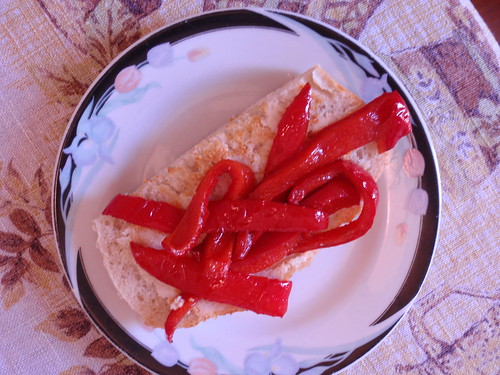
Ciabatta with Cashew Cheese and Roasted Red Peppers

That would be roasted red pepper slices on good bread with homemade cashew cheese.  This is the vegan’s answer to bread and cheese, and it’s really good.

I have to admit that I’ve been ambivalent about roasted red peppers for a long time.  It always seemed to me that people talked and wrote about them in dreamy, transcendent tones, and I didn’t understand what all the fuss was about.  Also, I was far too lazy to make my own roasted red peppers at home using that fussy method where you roast the peppers until the skins are blackened, then steam the peppers by sealing them in a bag after they come out of the oven, and finally you peel all the black skin off, leaving you with silky pepper slices.  Seriously—peel the peppers?  Are you kidding me?

Then last summer, I tried Nigel Slater’s roasted red peppers, and they were pretty tasty.  Most importantly, they were easy.  No peeling involved—just a few swipes of the knife and into the oven they go.  So I think I was already primed for Melissa Clark’s take on roasted red peppers, which she shares in Cook This Now: slice a few red bell peppers into thin slices, toss with olive oil, salt, and smoked paprika, and into the oven they go!  When they come out, they are tender, sweet, and savory, the flavor of the smoked paprika having permeated them in the heat.  The olive oil gives them some richness, and the salt balances everything out.

These roasted red pepper slices are so good that it’s tempting, very tempting, to eat them all straight off the roasting pan.  But if you can restrain yourself, drape them over a green salad or pile them onto some good bread.  And if you have more than two red peppers on hand, you might consider throwing all of them into this recipe.  I bought three last weekend and roasted two, thinking I’d save the last one…just in case?  I should have known better.  Roasting brings out the best in just about every vegetable, so why hold back?  Next time I won’t.

Check back here tomorrow for that homemade cashew cheese—it’s creamy, tangy, and the perfect counterpoint to the sweetness of roasted peppers.

Easy Roasted Red Pepper Slices

From Cook This Now by Melissa Clark

Serves 1-2

2 medium or large red bell peppers, cut into thin (~1/4-inch) slices

4 tsp. olive oil

1/2 tsp. kosher salt (I use Morton coarse kosher salt)

1/2 tsp. smoked paprika

1)  Preheat the oven to 375 degrees F.  In a small bowl, toss together the pepper slices and oil.  Add the salt and paprika, toss again, and spread the pepper slices on a baking sheet.

2)  Roast for about 25 minutes, until the peppers are tender, sweet, and completely delicious.  Serve hot or at room temperature, any way you like.  Or don’t bother serving them and just eat them straight off their baking pan.  If you share with me, I won’t tell anyone about your greediness.

Wednesday, April 4, 2012

Hitting the Wall

I am hitting the wall.

Not with vegan food, though!  I’ve made it through four days of vegan eating, and I’ve only been tempted to eat a cheese pizza once a day.  I’m kidding!  Well, maybe not entirely, but I have resisted all cheesy temptations and stuck to entirely plant-based food since Sunday.  I’ve been more or less eating as I always do, minus the milk, cheese, and yogurt.  There have been batches of noodle soup and lentil soup, and fresh strawberries, and overnight oatmeal made with soymilk and coconut milk.

Do I miss dairy right now?  Yes, but I don’t feel deprived.  And that’s really important, because my defenses are low right now.  My fellowship application is due in five days, my advisor is submitting our other grant tomorrow(!), and I am so tired of grant-related paperwork.  I’m hitting the wall.

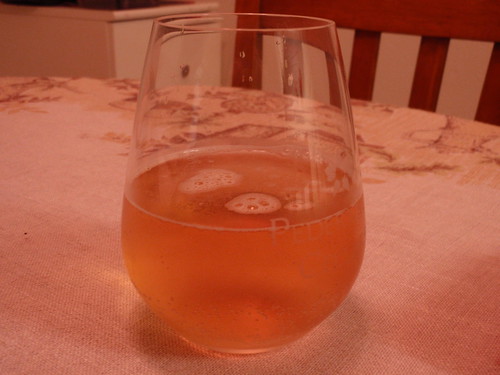
Tonight I had a more exciting post planned for you, but I had some last-minute paperwork to do, and I really needed a run tonight to clear my head and get my booty out of my chair.  I also really needed this glass of hard cider.

Wednesday Night Beverage 

Wish me luck, dear readers, as I head into the final stretch of this grant-writing season.  Five more days.  And I hope to be back here in a day or two with something more exciting and chewable.

(Five more days!)

Sunday, April 1, 2012

Coffee Tales

I would like to hire a few elves for my kitchen.  There would be the Dishwashing Elf, of course, because I cannot keep up with my output of dirty dishes.  There would be the Floor-Sweeping Elf, because a smooth, clean floor feels amazing against bare feet.  And there would be the Coffee-Buying Elf because I have a bad habit of waiting until I am out of coffee before buying a new bag.

Such was the state of things this morning.  I knew it was coming, but I forgot, probably because of last night’s margarita.  When I pulled out my almost-empty bag of coffee, I immediately began thinking about how to rectify this grave situation.  Is it wrong, I wondered, to go to a coffee shop in pajamas?  Really?  What if I’m just in-and-out, BOOM?  Am I really embarrassing myself, even highlighting my own chemical habit?

The answer, I decided, was yes.  I was too embarrassed to run to Blue Baker or Starbucks in pajamas, so I waited.  I ate breakfast, toodled around on the internet, showered, and dressed in my weekend uniform, which is pajama-like without being pajamas, and I rode my bike over to Starbucks for a pound of coffee.

Interestingly, perhaps even fortuitously, they were having a special deal at Starbucks this morning: buy a pound of whole bean coffee, get a free tall beverage!  I was tempted, very tempted, by the concept of free coffee, but then I remembered two very important things.  One is that I hate the idea of disposable cups, and I always feel a bit guilty whenever I buy a cup of coffee in a throwaway container.  I feel so guilty, in fact, that if it’s a plastic cup, I’ll take it home, wash it, and tuck it in the cupboard so I can reuse it.  Am I a little nuts about environmentalism?  Perhaps.  But why can’t Starbucks create a system to recycle all those coffee cups instead of putting them in the trash?

The other important thing is that I had homemade cinnamon syrup and storebought soymilk at home, and I wanted to make a big mug of coffee to fuel myself through some editing work.

Coffee Add-ins

So I took my pound of coffee and rode my bike home, where I proceeded to make myself a mug of coffee exactly the way that I like it, in a pretty orange mug and much less hand-wringing about trash.

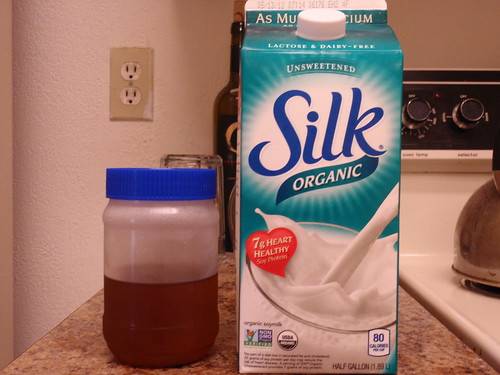
This morning was my first mug of coffee made with soymilk.  Actually, that’s not true.  I’ve had coffee with soymilk in the past and not liked it very much, but this time, with some friendly advice, I tried Silk’s organic soymilk.  It wasn’t half bad!  It’s still different from dairy milk, but different in an innocent way.  The flavor is not quite as rich as dairy milk, so the coffee is a bit blacker in flavor, but it certainly pushed all the right caffeinating buttons in me.

Along with the soymilk, I wanted to tell you about this cinnamon syrup I made, which is lovely and spicy and sweet.  Last week, deep in the trenches of grant-writing, I desperately wanted to relocate my office to Starbucks, where I could sip iced coffee, contemplate my own prose, and eavesdrop on any interesting characters.  On Friday, I finally gave myself permission to take my laptop to Starbucks and indulged in a two dollar coffee.

I don’t know about you, but these days, I feel like my spending is equivalent to pouring my money in a sieve, hence the frugal two dollar coffee.  But happily, you can get an iced coffee for two bucks, and you can even get a shot of syrup.  I chose the “cinnamon dulce” syrup, and wow, was it good!  Much less cloying than any of the pumpkin spice stuff that shows up in the fall, cinnamon dulce brightens with a spiciness that makes an iced coffee on a hot Texas afternoon even more refreshing.  It was really delicious.

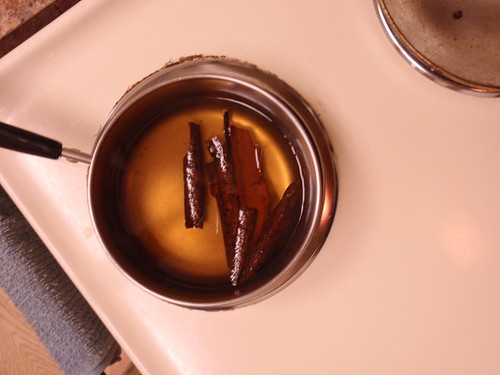
I liked it so much, in fact, that I went home that evening and made my own.  Or at least I made a cinnamon syrup inspired by Starbucks’s.  It was super easy too—just simmer sugar with water until the sugar is dissolved, then throw some cinnamon bark into the syrup and simmer for a few minutes.  Cool the syrup and fish the cinnamon out, then pour into a little container and store it in the fridge.

Making Cinnamon Syrup,

I like to add about a tablespoon of this syrup to my morning coffee in lieu of sugar.  Best of all, it gets along well with soymilk!

Cinnamon-Infused Simple Syrup

Syrup-making instructions borrowed gratefully from In the Kitchen with a Good Appetite by Melissa Clark

I used cinnamon barks in this recipe, which you can buy at Indian grocery stores or, around here, certain gas stations that also sell Indian foods.  I’m sure cinnamon sticks would be fine too—I’d use four or five sticks to make the syrup nice and potent.

1 cup water

1/2 cup granulated sugar

5 cinnamon barks (see headnote)

1)  Bring the water and sugar to a boil in a small saucepan.  Stir to dissolve the sugar, then reduce the heat to medium and add the cinnamon barks.

2)  Simmer for 3-4 minutes, then turn off the heat and let the syrup cool.

3)  Fish out the cinnamon, then pour the syrup in a jar and store covered in the fridge.